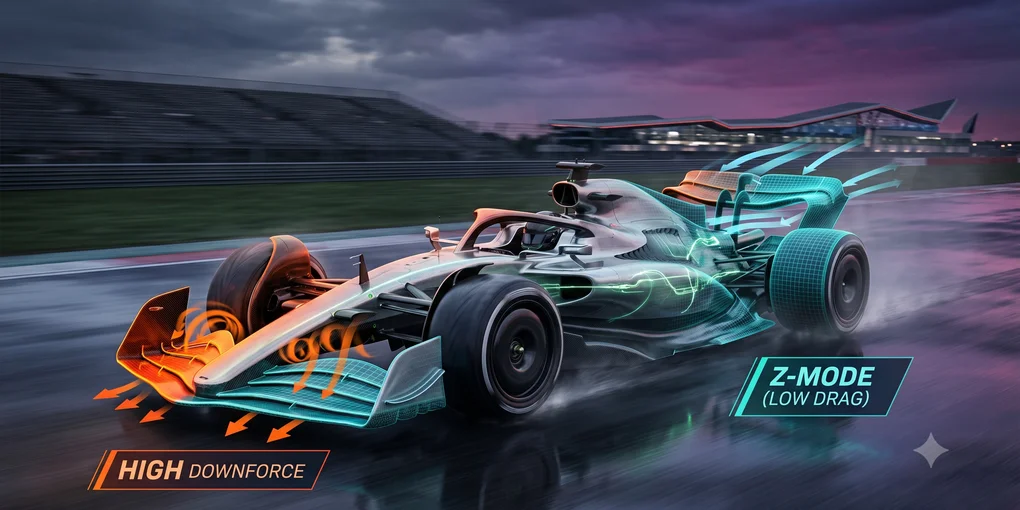
F1 2026: Active Aero and 'Z-Mode'
Formula 1 has always been an arms race of marginal gains, but every few years, the FIA drops a regulatory hammer that forces teams to completely reinvent the wheel—or, in this case, the wings. With the F1 race going on this weekend at the Circuit de Barcelona-Catalunya, a high speed circuit with two long straights, many sweeping turns and a couple tight chicanes, I want to dive into the new aerodynamic rules recently introduced for the 2026 season.
The current 2026 technical regulations represent one of the most radical paradigm shifts in the history of motorsport. At the heart of this revolution is a massive overhaul of the power unit, pushing for an almost equal 50/50 split between the internal combustion engine (ICE) and electrical hybrid power (up to 350 kW).
But there is a major engineering problem: heavy batteries require heavy compromises. To offset the massive drag and energy recovery demands of these new power units, the FIA has turned to a highly controversial, incredibly complex solution: mandatory, active aerodynamics.
In this post, we’re going to look past the marketing speak and dive deep into the engineering realities of 2026 active aero, the computational bottlenecks of simulating these systems, and the terrifying safety risks of software-defined downforce at 200 mph.
Demystifying Active Aero: Z-Mode vs. X-Mode
Under the previous regulations, aerodynamicists design cars around a single compromise: find a sweet spot of downforce for the corners without creating so much drag that the car becomes a brick on the straights. The only active element allowed was DRS (Drag Reduction System), a simple hinged flap on the rear wing used exclusively for overtaking.
In 2026, that compromise is out the window. Cars feature active, dual-state aerodynamic systems on both the front and rear wings. These systems will operate in two distinct profiles:
- Z-Mode (High Downforce): This is the baseline cornering state. The front and rear wing flaps deploy to their maximum angles of attack, maximizing downforce to pull the car through corners as quickly as possible.
- X-Mode (Low Drag): On the straights, the car transitions into a ultra-low drag state. The rear wing flaps open up, and the front wing flaps flatten out synchronously. This reduces aerodynamic drag by an estimated 55%, allowing the car to hit competitive top speeds despite having a less powerful internal combustion engine.
F1 Aerodynamics Simulator
Explore how active aero transforms car behavior
What makes this system incredibly complex is aerodynamic balance. If you only reduced drag on the rear wing (like we do with current DRS), the loss of rear downforce paired with high front downforce would shift the aerodynamic center of pressure far forward. At high speeds, this would make the car instantly spin out.
To keep the car balanced, the front and rear wings must shed downforce in perfect, synchronized harmony.
The Simulation Bottleneck: Modeling Transient Flow
As someone with a tech background, this is where the engineering gets fascinating. F1 teams rely heavily on Computational Fluid Dynamics (CFD) to design their cars. However, under current regulations, the FIA strictly limits the amount of wind tunnel time and supercomputing resource (measured in Mega-Allocation Unit hours, or MAUh) a team can use.
Traditionally, aerodynamicists run steady-state CFD simulations. They model the car at a specific velocity, ride height, and steer angle, and let the simulator calculate the static forces.
For 2026, steady-state simulations are practically useless. The real engineering battleground is in transient aerodynamics—modeling the exact moment the wing flaps transition from Z-Mode to X-Mode.
       [ Z-Mode ]  -------- (Transition State) -------->  [ X-Mode ]
    Max Downforce            * Dynamic Vortex Shedding      Min Drag
                             * Unsteady Boundary Layers
                             * Massive Balance Shifts
During this split-second transition, several fluid dynamics headaches occur:
- Dynamic Vortex Shedding: As the wing angles change rapidly, they shed massive, unpredictable vortices that travel down the bodywork, impacting the floor’s ground-effect performance.
- Boundary Layer Separation: The air flowing over the wings can momentarily stall or detach, leading to sudden, non-linear drops in downforce before the airflow stabilizes in its new state.
- Delayed Aerodynamic Response: The front wing changes state first in terms of physical airflow path, while the wake takes several milliseconds to reach the rear wing. If not modeled correctly, this creates a momentary, catastrophic balance shift.
To model this, teams must deploy highly resource-intensive Detached Eddy Simulations (DES) and Large Eddy Simulations (LES). These models require massive supercomputing clusters to track how turbulent air behaves over time, rather than just in static snapshots.
With the FIA’s strict limits on compute power, the teams that win the 2026 championship won’t just have the best aerodynamicists; they will have the best software engineers who know how to optimize CFD code to get the most accurate transient results out of limited supercomputing budgets.
Software-Defined Downforce: The Safety Nightmare
When you replace mechanical grip and passive aerodynamics with software-controlled actuators, you introduce a terrifying point of failure.
Imagine a driver flying down the straight at Monza at 220 mph in X-Mode. They approach the heavy braking zone of Turn 1. To make the corner, the car must instantly transition to Z-Mode to regain downforce.
If a sensor fails, a hydraulic line ruptures, or a software bug occurs, and the wings get stuck in X-Mode, the driver will press the brakes with virtually zero downforce. The car will simply sail off the track and into the barrier.
During early simulator testing of the draft 2026 regulations, several drivers reportedly experienced “scary” spins on the simulator when the rear aero shifted states but the front didn’t, proving how delicate this balance is.
Designing Fail-Safes into the System
To prevent catastrophic failures, F1 teams and the FIA are designing deep hardware and software redundancies:
- Aerodynamic Fail-Safe (Spring-Loaded Defaults): The actuators must be designed so that in the event of a total hydraulic or electrical loss, the natural aerodynamic forces (or physical springs) automatically push the wing flaps back into the high-downforce Z-Mode configuration. It is always safer to have too much drag on a straight than too little downforce in a corner.
- Triple Modular Redundancy (TMR): Critical sensors—such as suspension travel sensors, pitot tubes, and IMUs (Inertial Measurement Units)—will likely run in triplicate. The onboard Electronic Control Unit (ECU) will use voting logic: if two sensors say the car is braking but one says it’s flat-out, the system overrides the outlier and deploys Z-Mode.
- Deterministic Control Loops: The software controlling these transitions cannot run on standard operating systems. They require hard Real-Time Operating Systems (RTOS) running on the standard FIA ECU, ensuring that the control loops responsible for wing transitions execute within strict, millisecond-level time bounds with absolute predictability.
The Verdict: A New Era of Systems Engineering
The 2026 Formula 1 regulations are going to receive a lot of criticism. Purists will argue that “active aero” detracts from pure mechanical driving skill, turning F1 cars into software-controlled drones.
But as an engineer, I find this era incredibly exciting. Formula 1 has always been about pushing technology to its absolute limit. By introducing active aerodynamics, the sport is transforming from pure aerodynamic optimization to highly complex, multi-disciplinary systems engineering.
The team that masters the integration of control software, transient CFD simulation, and fail-safe mechanical design will dominate the grid in 2026. One thing is certain: the race track is about to become a very high-speed, high-stakes software laboratory.