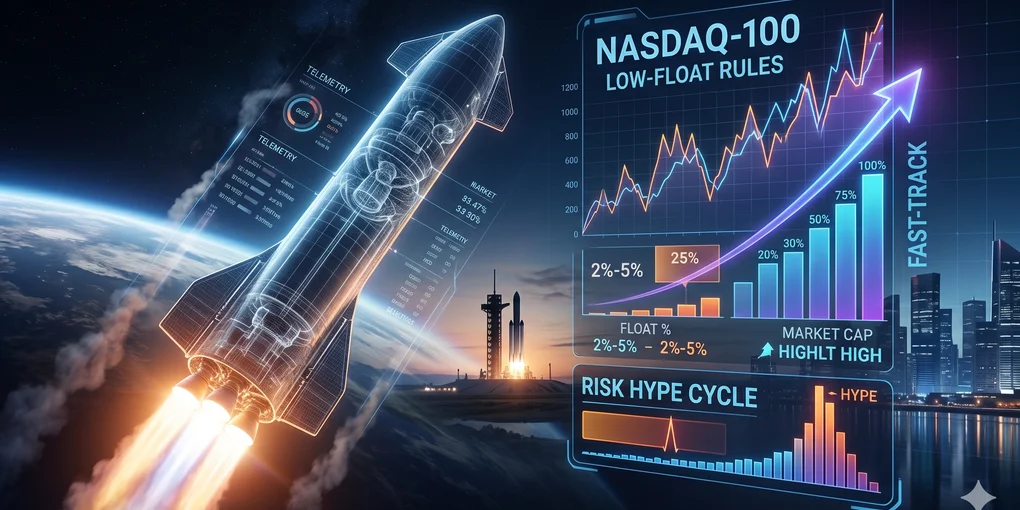
Implications of NASDAQ's New Low-Float Rules for SpaceX's IPO
When I look at the aerospace industry, I rarely view it through the lens of pure rocketry. As engineers, we love to obsess over the specific impulse of Raptor engines, the thermal dynamics of hexagonal heat tiles, and the sheer audacity of catching a super-heavy booster with mechanical chopsticks. But behind every successful orbital insertion is an equally complex feat of financial engineering.
For years, the tech and finance worlds have been holding their breath for a SpaceX Initial Public Offering (IPO). The narrative was always that Elon Musk would wait until regular flights to Mars were underway before submitting to the whims of the public market. But the macro environment is shifting. With NASDAQ’s recent May amendments altering the landscape for low-float stocks, the calculus has changed.
We are no longer just looking at a speculative event. We are looking at a highly engineered financial mechanism designed to fuel a generational leap in spaceflight, while carefully insulating its founder from Wall Street’s short-termism. Let’s break down the mechanics of the SpaceX IPO equation.
Decoding the May NASDAQ Rule Amendments
To understand why an IPO suddenly looks so appealing for a closely-held juggernaut like SpaceX, we have to parse the recent regulatory tweaks. Earlier this year, NASDAQ quietly rolled out rule modifications aimed at fast-tracking low-float stocks and significantly shortening the “seasoning period” required for inclusion in the coveted NASDAQ-100 index.
Traditionally, entering the NDX required a massive, highly liquid public float. This was a protective measure to ensure that the heavy-hitting passive index funds (like Invesco’s QQQ) could buy in and out without triggering violent price dislocations.
The new amendments shift this paradigm. By lowering the float threshold and accelerating the timeline for mega-cap private entries, NASDAQ is essentially laying out the red carpet for unicorns that want to stay private in spirit but public in valuation.
Here is how this mechanism functions under the hood:
- The Low-Float Loophole: A company can now float a fractional percentage of its total equity (e.g., 2% to 5%) while still qualifying for top-tier index inclusion based on its overall market capitalization.
- The Passive Liquidity Vacuum: Once added to the NASDAQ-100, trillions of dollars in passive ETF capital are mandated to buy the stock.
- The Scarcity Multiplier: When inelastic, price-agnostic buying meets a highly restricted supply of shares (low float), the resulting price action is explosive.
From an engineering perspective, it’s a brilliant piece of impedance matching. It allows a massive, capital-hungry private entity to interface with the world’s deepest liquidity pools with minimal loss of structural control.
SpaceX IPO Simulator
Model the dynamics of a low-float mega-cap IPO
The Capital Intensity of Starship and Starlink
Why does SpaceX need public markets now? The answer lies in the dual-engine architecture of the company: Starlink and Starship.
Starlink is the cash cow. It is a marvel of telecommunications architecture, but maintaining and upgrading a constellation of tens of thousands of low-earth-orbit (LEO) satellites requires relentless Capital Expenditure (CAPEX). You don’t just launch Starlink once; you constantly refresh the hardware, upgrade the laser inter-satellite links, and scale ground station infrastructure.
Then there is Starship. Starship is a capital black hole by design. SpaceX’s development methodology—often summarized as “build, fly, explode, iterate”—is phenomenally successful from an engineering standpoint. Hardware-rich development gathers real-world data faster than any software simulation ever could. But vaporizing hundreds of millions of dollars in stainless steel and methane on the pad requires a balance sheet of sovereign proportions.
Private markets, while deep, are showing fatigue. The venture capital pools capable of writing multi-billion-dollar checks without demanding immediate profitability are drying up. SpaceX needs the public markets.
However, Musk has a well-documented disdain for the quarterly earnings treadmill. He knows that traditional public shareholders would demand he maximize Starlink’s margins rather than pour billions into a highly speculative Mars colonization effort.
This is where the new NASDAQ rules become the ultimate enabler. A low-float IPO allows SpaceX to:
- Raise immense capital by selling a tiny sliver of the company at a staggering valuation.
- Retain absolute operational control through super-voting share structures and a heavily restricted float.
- Reward long-term employees by finally giving them a liquid market for their equity without requiring a traditional, wide-open public debut.
Systemic Risk vs. Generational Tech
While this structure is beautifully optimized for SpaceX, it introduces a fascinating—and terrifying—dynamic to the broader market. We have to weigh the systemic risk of this financial vehicle against the realities of deep-tech engineering.
If SpaceX IPOs under these conditions, it will immediately become the most hyped equity in modern history. The retail frenzy would dwarf the meme-stock craze of 2021, driven by genuine retail belief in the mission and the sheer cultural gravity of the company.
But aerospace engineering is unforgiving. Unlike software, where a bad deployment means a 404 error and a quick rollback, a bad deployment in aerospace means a catastrophic kinetic event. Rockets blow up. Timelines slip. Physics cannot be negotiated with.
Imagine the systemic vulnerability when a low-float, astronomically hyped stock is fast-tracked into the NASDAQ-100. Because of the low float, the stock will carry a massive “beta”—it will be hyper-volatile.
- The Bull Case: A successful crewed Starship landing on the Moon sends the stock up 40% in a day, artificially dragging the entire NASDAQ index higher due to its outsized market cap weighting.
- The Bear Case: A catastrophic failure of a Starship booster on the pad destroys Ground Support Equipment, grounding the fleet for 18 months. The retail panic selling, combined with the lack of float liquidity, triggers a violent downward halt, cascading into the ETFs holding the stock.
We are looking at a scenario where the retirement accounts of millions of passive investors become indirectly leveraged to the pressure and temperature telemetry of a Raptor engine over the Gulf of Mexico.
The Final Calculation
As a tech observer and an engineer, I find the potential SpaceX IPO endlessly fascinating. It is a collision of two vastly different worlds. On one side, you have the unforgiving, deterministic laws of orbital mechanics. On the other, the highly emotional, deeply psychological, and entirely synthetic rules of modern financial markets.
By leveraging NASDAQ’s new low-float amendments, SpaceX has the opportunity to build a capital machine just as powerful and efficient as the Starship itself. It is a masterclass in financial engineering, designed to fund a multi-planetary future without surrendering the helm to Wall Street.
But as with any highly optimized system, the tolerances are incredibly tight. A low-float, hyper-valued aerospace stock embedded in our major indexes means we will all be along for the ride.
Fasten your seatbelts. The countdown might have already started.