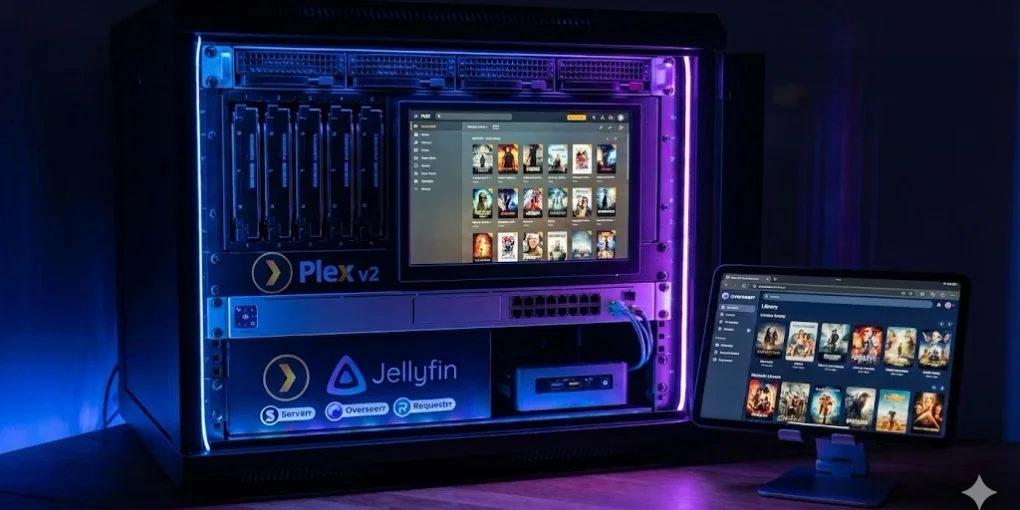
Reimagining Home Media: The 2025 Server and the Future of a Plex Loyalty
A Server to Keep … or Not?
The 2025 home media landscape delivers its usual mix of polished convenience and open-source rebellion. Jellyfin continues to gain ground, converting privacy advocates with its free hardware transcoding and lack of corporate bloat. Yet, for many of us, the decision remains an exercise in precision and practical inertia—despite the introduction of compelling free alternatives, the “it just works” factor of Plex continues to define the user experience.
The Open Source Temptation
Plex is synonymous with the self-hosted revolution, yet that heritage has come under fire in recent years. Critics argue that the platform’s increasingly commercialized focus—shifting toward ad-supported streaming and social features—betrays the core mission of a personal media server. This year was no exception. Self-hosters and privacy advocates alike described the modern Plex experience as “cluttered,” with some even jokingly remarking they need a map to find their own local libraries amidst the rentals and live TV.
The problem is structural: as Plex grows larger and more corporate, it simply cannot pivot as quickly as the community-driven Jellyfin, which offers a “pure” experience free of paywalls. Even loyalists have admitted that while the Plex UI excites with its polish, the actual administration often feels like a battle against features nobody asked for.
Proposals for a Revitalized Stack
However, the blame for a stagnant media setup is not placed solely on the software. Influential voices in the self-hosted community suggest that the server itself is often in need of thoughtful modifications. For me, the answer wasn’t to abandon ship, but to double down on “Plex v2.”
The Lifetime Factor
I’ve been a Plex Pass lifetime user since 2020. That investment is the “pole position” of my setup—a sunk cost that makes switching to Jellyfin a non-starter. My previous build, born during the extreme boredom of the 2020 shutdowns, was a humble $5 DigitalOcean droplet designed to serve friends and family who were locked inside. It was a race against isolation, and Plex was the reliable engine that powered it.
The Automation Upgrades
My latest rendition, Plex v2, isn’t just about storage; it’s about workflow. I’ve integrated the full Servarr stack, transforming the server from a manual library into an automated beast. By adding Overseerr, I’ve given my users a “Netflix-like” interface to request content, removing the friction of text messages and manual downloads. For the discord-savvy among them, Requestrr adds a chatbot layer that feels almost magical.
An Ultimatum for the Future of My Lab
There is an undeniable legacy attached to my Plex server. Yet, without these meaningful changes—adding automation and request management—my setup’s status as the crown jewel of my friend group might have come to an end. As the self-hosted world evolves and Jellyfin grows ever more capable, the pressure is on. But for now, with the polish of the Plex client and the power of the Servarr stack backend, I’m not ready to exit the ecosystem just yet.
The future of my home lab hangs in the balance. With the longstanding tradition of my Lifetime Pass on one side and the calls for open-source freedom on the other, the next few seasons will be critical. But for 2025? Plex stays on the podium.