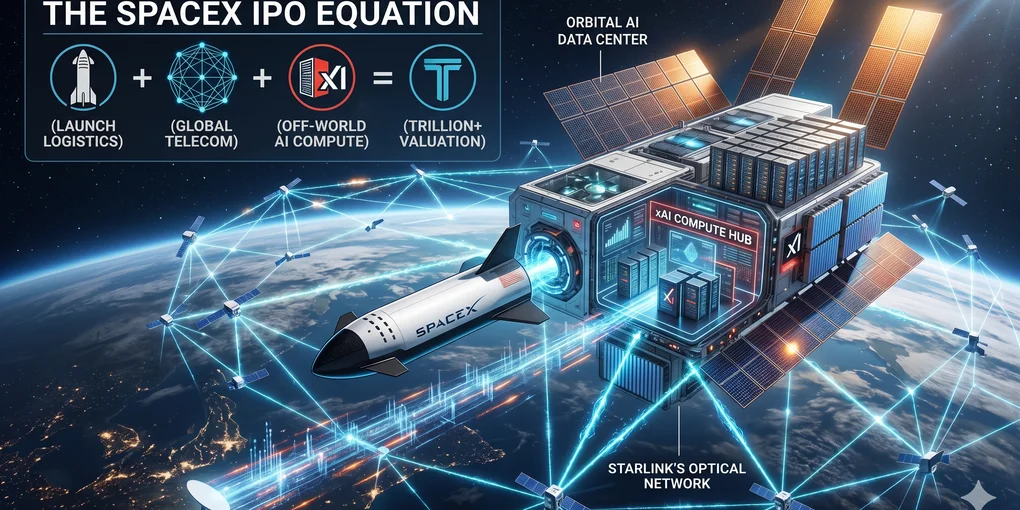
The SpaceX IPO Equation: Why Orbiting Data Centers Just Changed the Math
When SpaceX goes public on June 12, 2026, it won’t be evaluated like a traditional aerospace contractor. Wall Street will try to price it as a logistics network, a global telecom, and a defense contractor rolled into one. At $135 per share, the target valuation of $1.77 trillion seems astronomical on its face—until you break down the actual math.
For a long time, the “SpaceX IPO Equation” was relatively simple to understand, even if it was hard for competitors to replicate. It was a two-variable formula:
Valuation = (Launch Monopoly) + (Starlink Recurring Revenue)
But as the AI revolution accelerates, the power grid constraints on Earth are becoming a hard bottleneck for compute. This introduces a massive, previously unpriced third variable into the SpaceX equation: In-Space Data Centers powered by xAI.
Here is the new equation driving the ultimate valuation of SpaceX.
Variable 1: The Launch Monopoly (Starship & Falcon)
The foundational variable remains SpaceX’s near-monopoly on orbital launch. Falcon 9 already delivers the vast majority of the world’s payload to orbit. But it is Starship that fundamentally alters the physics and economics of space logistics.
Currently, a Falcon 9 launch costs around $67 million, putting the payload cost to Low Earth Orbit (LEO) at approximately $3,000 per kilogram. Starship, with its fully reusable architecture, is projected to drive launch costs down to just $10 million per flight at scale. By delivering 150 to 250 tons to orbit per launch, Starship achieves a staggering cost compression to under $50 per kilogram. This 98% reduction in cost-to-orbit transforms space access from a capital-intensive bottleneck into a cheap logistical toll road, inducing demand and making entirely new space-based business models economically viable.
Variable 2: Starlink’s Recurring Revenue Engine
If rockets are the delivery trucks, Starlink is the cargo that pays the bills. Starlink transformed SpaceX from a hardware company reliant on sporadic government contracts into a high-margin, recurring-revenue machine.
In 2025, Starlink reported $11.4 billion in revenue—representing 61% of SpaceX’s total sales. Even more impressive is its profitability: operating at a massive 63% adjusted EBITDA margin, Starlink generated roughly $7.2 billion in earnings. With a subscriber base that doubled to over 10 million active users by early 2026, Starlink provides the predictable cash flow that institutional investors crave. But Starlink’s true superpower isn’t just beaming internet to rural homes—it’s the optical laser mesh network operating in LEO. This network sets the stage for SpaceX’s next multi-trillion-dollar vertical.
Variable 3 (The Multiplier): Space Data Centers and xAI
As artificial intelligence scales, companies are running into a terrestrial wall: energy and cooling. Training and running models like xAI’s Grok require gigawatt-scale data centers that strain local power grids and consume millions of gallons of water.
Goldman Sachs projects that xAI’s revenue will surge 100-fold from $3.2 billion in 2025 to $322 billion by 2030. To support this massive Total Addressable Market (TAM), currently estimated at $26.5 trillion, SpaceX is uniquely positioned to build Orbital Data Centers.
Here is the engineering reality of space-based compute:
- Infinite, Uninterrupted Energy: Solar arrays in orbit collect energy 24/7, yielding significantly higher power generation without atmospheric interference or nighttime interruptions.
- Thermal Radiation Cooling: Contrary to the popular myth that space is “cold” and provides free cooling, space is a vacuum, meaning traditional convection cooling entirely fails. Instead, heat must be rejected through thermal radiation governed by the Stefan-Boltzmann law:
Where is radiated power, is radiator surface area, is emissivity, is the Stefan-Boltzmann constant, and is absolute temperature. To dissipate the waste heat of a standard 50MW terrestrial data center in orbit, you would need roughly 165,000 square meters of thermal radiators—the equivalent of 22 football fields! However, Starship’s unprecedented 250-ton payload capacity is exactly what makes launching these massive deployable radiator arrays economically viable.
- Seamless Data Transfer: Starlink’s existing LEO laser-link network acts as the high-speed fiber-optic backbone, transmitting compute inputs and outputs globally with lower latency than undersea cables.
By launching modular AI data centers into orbit, SpaceX transitions from an internet provider to an off-world cloud computing provider. xAI serves as the perfect anchor tenant, utilizing space compute to train its frontier models without being throttled by Earth’s energy grid.
Eventually, SpaceX can lease out orbital server space to other tech giants, creating an “AWS of Space.” This unlocks a massive new TAM that bridges the aerospace and cloud infrastructure sectors.
The Final Equation
When underwriters price the SpaceX IPO on June 12, they won’t just be looking at rockets or internet dishes. They will be looking at a vertically integrated empire that owns the transport layer (Starship), the communication layer (Starlink), and the compute layer (Orbital Data Centers & xAI).
The New SpaceX IPO Equation:
SpaceX Valuation ($1.77T) = Starship Logistics (<$50/kg) + Starlink Telecom ($11.4B ARR) + xAI Space Compute ($322B TAM by 2030)
By solving the terrestrial bottlenecks of AI data centers, SpaceX isn’t just reaching for the stars—it’s actively moving the digital economy into orbit. And when the IPO day finally comes, the market will realize that a $1.77 trillion valuation might actually be a bargain.