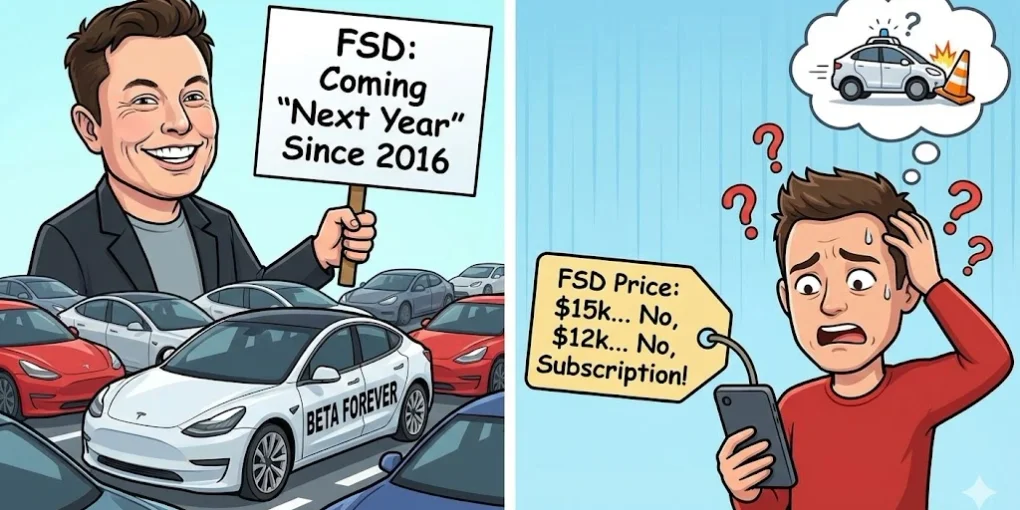
The End of an Era: Why Tesla’s FSD Shift Feels Like a Turning Point (For Better or Worse)
If you’ve been following the Tesla world as closely as I have, you probably saw the latest update from AI DRIVR regarding the future of Full Self-Driving. If you missed it, brace yourself: the era of “owning” FSD is officially coming to an end.
According to the latest news dropped by Elon, starting February 14th, you will no longer be able to buy FSD outright. It’s shifting exclusively to a monthly subscription model.
As I sat there watching AI DRIVR break this down, I found myself nodding along—but also feeling a knot of anxiety for the community. This is a huge shift, and honestly? It’s complicated.
The “Ownership” Myth
Let’s be real for a second. We’ve all known deep down that the “lifetime license” was getting weird. I remember when FSD was $15,000. It felt like an investment in a robotaxi future that was just around the corner. AI DRIVR points out that this move to subscription-only probably comes from internal data showing that selling lifetime licenses just doesn’t make business sense anymore. And he’s right—it’s a smart corporate move.
But for those of us who already dropped the cash? It’s scary.
The Elephant in the Room: Musk’s Comp Package
One thing AI DRIVR didn’t mention, however, is the rationale behind this sudden switch. While he suggests internal data is the driver, I have a different theory: Elon Musk’s massive compensation package.
Included in the targets for that package is a requirement for Tesla to reach 1 million+ FSD subscriptions. When you look at it through that lens, the sunsetting of the outright purchase option becomes blindingly obvious. They need to pump those recurring revenue numbers up, and fast.
It also makes you question the current pricing. Sure, the subscription is only $99/month right now, but it wasn’t long ago that it was sitting at $199. Nothing stops Tesla from cranking that price back up in the future. In fact, I suspect they will increase it the moment the software gets good enough that people feel they “can’t live without it.” We are walking into a trap where the entry price is low, but the ceiling is nonexistent.
The Shareholder vs. Owner Dilemma
This is where I find myself torn in two. As a Tesla shareholder, I actually applaud this move. Shifting to a subscription model stabilizes revenue and forces the kind of recurring cash flow that makes stock charts look very healthy. If I look at this purely from my investment portfolio, it means better returns and a more sustainable business model.
But then I step into my garage, look at my 2020 Model 3, and the frustration sets in. My car is running Hardware 3 (HW3), and we’ve reached the point where FSD has advanced so much that my hardware can no longer support the latest updates. It is incredibly unfortunate to support a company’s vision for years, only to be hardware-locked out of the finish line.
I would love to see Tesla offer a retrofit option for us—paid or free, I honestly don’t care. With my background in tech, I don’t see this as an insurmountable engineering challenge. We are talking about swapping out the compute computer (CPU/GPU) and upgrading the cameras. The real bottleneck isn’t technology; it’s logistics. The added burden on Tesla Service Centers to perform these upgrades would be massive, and pricing it fairly without alienating long-time fans would be a tightrope walk. But if they want to keep the “early adopters” happy, it’s a walk they need to take.
The Hardware 3 Heartbreak
The part of the video that really hit home for me was the discussion about existing owners, specifically those like me with Hardware 3 vehicles. There are people out there who paid the full price, supported the mission early on, and now their cars can’t even run the latest, buttery-smooth versions of the software.
AI DRIVR put it perfectly: if Tesla doesn’t allow these owners to transfer their FSD to a new car permanently, it’s going to feel like a “giant kick in the balls.” I couldn’t agree more. These are the people who funded the data collection that made the current software possible.
My take? Tesla needs to make FSD transfers permanent. Immediately. It would instantly boost the resale value of our cars and, more importantly, lock in brand loyalty for life. If I know my $8k or $15k investment travels with me, I’m buying another Tesla. If it dies with the car? I might start looking elsewhere.
Don’t Buy It (Right Now)
One piece of advice from the video that I want to echo loudly: Do not buy FSD outright right now.
We are in a limbo period with zero guidance. As it stands, FSD is tied to your VIN. If you buy it today and get totaled tomorrow, that money evaporates. AI DRIVR suggested a dream scenario where FSD is tied to your Tesla Account rather than the car. That would be the ethical way to handle this, but until that happens, the subscription is the only safe bet.
The “Boring” Future of Driving
On a lighter note, it is wild to hear how good the tech is getting. AI DRIVR mentioned that his reviews are becoming difficult to make because the car is just… good. It’s “boring” in the best possible way. The errors are disappearing.
We are apparently on the verge of the car actually reasoning—thinking about which parking spot is safest or understanding complex signage. It’s exciting, but it also makes the ownership question even more urgent. If the car is finally becoming the sci-fi dream we were promised, I want to make sure I still have access to it without paying a monthly rent forever.
Personally, I’ve experienced FSD in action as a driver and passenger, and the technology is amazing. Those that haven’t experienced it themselves, I implore you to go request a test drive from Tesla today! Tesla’s self-driving tech is leaps and bounds ahead of their competitors. Other car manufacturers are playing catch up while Tesla continues to lead the race.