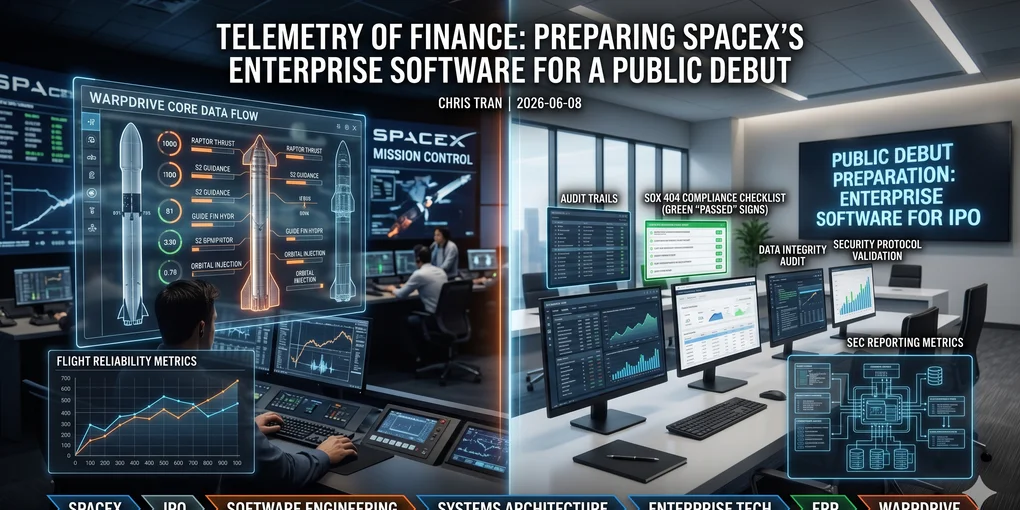
The Telemetry of Finance: Preparing SpaceX's Enterprise Software for a Public Debut
At Starbase in Boca Chica, Texas, success is measured in telemetry. Thousands of sensor channels stream temperature, pressure, and strain data back to ground control in real-time. If a valve behaves unexpectedly, the software triggers an automated abort. It is a highly optimized, fast-loop engineering environment where rapid prototyping, hardware-in-the-loop testing, and instant iteration are the status quo.
But with SpaceX’s historic IPO officially scheduled for this Friday, June 12, 2026, Elon Musk’s aerospace giant faces an entirely different class of mission control: the Securities and Exchange Commission (SEC).
In the public markets, telemetry is spelled compliance, and abort triggers are called internal controls.
Transitioning a deeply integrated, highly customized aerospace software ecosystem from private ownership to public-market accountability is an engineering challenge of planetary proportions. How does a company that prides itself on breaking things to learn fast adapt to the zero-tolerance, highly regulated world of Sarbanes-Oxley (SOX) compliance and public financial auditing?
Let’s look under the hood at how SpaceX’s custom enterprise architecture has evolved to bridge the gap between rocket science and financial compliance as the clock ticks down to Friday’s opening bell.
Auditing the Un-auditable: SOX 404 vs. Rapid Prototyping
For a private company, a software bug in a ground control UI might cost a few hours of downtime. For a publicly traded entity, a bug in the software that tracks asset valuation or inventory depreciation can result in a material weakness disclosure, a tanking stock price, and shareholder lawsuits.
The core of this challenge is Sarbanes-Oxley (SOX) Section 404, which mandates that public companies establish, maintain, and assess an adequate internal control structure for financial reporting.
[Developer Commits Code]
          │
          ▼
┌─────────────────────────────────┐
│     Automated CI/CD Pipeline    │
├─────────────────────────────────┤
│ 1. Static Analysis (SonarQube)  │
│ 2. Unit & Integration Tests     │
│ 3. ITAR Leak Detection Scan     │
└─────────────────────────────────┘
          │
          ▼
┌─────────────────────────────────┐
│     SOX Compliance Gateway      │
├─────────────────────────────────┤
│ - Cryptographic Sign-Off Check   │
│ - Segregation of Duties Verified│
└─────────────────────────────────┘
          │
          ▼
[Production Deployment to WarpDrive]
In standard enterprise environments, SOX compliance is achieved by slowing down. Changes to financial systems go through layers of manual approvals, cabalistic change advisory boards, and slow-moving release cycles.
To a SpaceX software engineer, that workflow is an existential threat to development speed. To survive an IPO without stalling Starship’s development, SpaceX has built compliance-as-code directly into their CI/CD pipelines.
Automating Segregation of Duties (SoD)
SOX requires strict Segregation of Duties: the developer who writes the code cannot be the person who deploys it to production, and the engineer who initiates a parts purchase cannot be the one who approves the invoice.
To maintain velocity, SpaceX has automated these cryptographic verifications:
- Infrastructure as Code (IaC) Sign-offs: Any change to infrastructure hosting financial, supply chain, or launch manifest data must be cryptographically signed by multiple authorized peers.
- Deterministic Build Pipelines: The build system must generate an immutable, tamper-proof bill of materials (SBOM) for every software release, verifying that the compiled binaries deployed to the production servers match the audited source code exactly.
- Continuous Auditing: Instead of quarterly manual audits, SpaceX’s internal systems programmatically verify compliance. If a developer bypasses a branch protection rule, automated alerts immediately quarantine the environment and flag the exception in an immutable audit log.
WarpDrive: The Custom Monolith Confronts Public Accountability
Most Fortune 500 companies run on SAP, Oracle, or Microsoft Dynamics. SpaceX famously rejected this path, choosing instead to build WarpDrive, their highly customized, proprietary ERP (Enterprise Resource Planning) system.
WarpDrive is the central nervous system of SpaceX. It tracks everything: the serial number of a 3D-printed Raptor engine valve, the procurement of raw sheet metal, launch scheduling, satellite manufacturing queues, and employee payroll.
# A conceptual representation of a WarpDrive transaction ledger entry
transaction_id: "tx_9921a8f9-b3c1"
timestamp: "2026-06-09T14:32:01.004Z"
asset:
  type: "Falcon9_Booster"
  serial_number: "B1085"
action: "Refurbishment_Completed"
costs_incurred:
  labor_hours: 142.5
  parts_consumed: ["val_9912", "seal_0021"]
depreciation_update:
  method: "Per_Launch_Units_of_Production"
  remaining_useful_life_launches: 14
authorized_by: "system_agent_automation_refurb"
signature: "0x8f7a...92b4"
While WarpDrive gives SpaceX unparalleled vertical integration and speed, it presents unique challenges for public-market auditors who are used to auditing standardized SAP ledgers.
The Challenge of Reusable Rockets as Capital Assets
In standard accounting, depreciating a fleet of delivery trucks is trivial. But how do you write the accounting logic for a Falcon 9 booster that is designed to fly 20+ times, gets refurbished after every flight, and occasionally suffers a “rapid unscheduled disassembly”?
Under GAAP (Generally Accepted Accounting Principles), SpaceX’s WarpDrive has been updated to dynamically calculate:
- Dynamic Depreciation: Calculating the asset value of a booster based on its telemetry-proven wear-and-tear and launch history, rather than simple straight-line time depreciation.
- Work-In-Progress (WIP) Valuation: Starbase is littered with Starship prototypes in various stages of construction, testing, and scrapping. WarpDrive must accurately categorize which steel rings are capital expenses (CapEx) for operational vehicles and which are immediate research and development (R&D) expenses.
To pass a Big Four financial audit, WarpDrive’s custom ledgers can no longer operate with the flexibility of a private company’s database. Every table, state machine, and API endpoint dealing with inventory, assets, and launch costs has been refactored to support strict double-entry ledger databases (like Amazon QLDB or custom ledger databases with cryptographic block hashing) to guarantee that financial records are structurally immutable.
Security at Scale: ITAR vs. SEC Transparency
Perhaps the most complex challenge of a SpaceX public debut is the direct collision between two highly protective federal bodies: the State Department (enforcing ITAR) and the SEC.
As a rocket manufacturer, SpaceX’s software, engineering specs, and launch telemetry fall under ITAR (International Traffic in Arms Regulations). Under ITAR, sharing technical data about rocket propulsion, guidance systems, or telemetry with non-U.S. persons is a severe federal crime.
Conversely, the SEC demands extreme transparency. If a Starship launch fails, or if a block of Starlink satellites fails in orbit, that is a material event. Public shareholders have a legal right to understand the root cause of the failure and its financial impact.
                    ┌───────────────────────────┐
                    │  Raw Engineering Systems  │
                    │   (Flight Telemetry)      │
                    └─────────────┬─────────────┘
                                  │ Contains ITAR Data
                                  ▼
                    ┌───────────────────────────┐
                    │   Data Sanitization and   │
                    │     Anonymization Core    │
                    └─────────────┬─────────────┘
                                  │ ITAR Stripped /
                                  │ Aggregated Metrics Only
                                  ▼
                    ┌───────────────────────────┐
                    │    WarpDrive Financial    │
                    │      & SEC Reporting      │
                    └───────────────────────────┘
To resolve this conflict, SpaceX’s enterprise software architecture implements a zero-trust, highly segregated data pipeline:
- The Data Air-Gap: SpaceX maintains a distinct, programmatic barrier between engineering databases containing ITAR-controlled technical telemetry and financial reporting databases.
- Automated Data Sanitization: When a material launch anomaly occurs, automated systems extract the financial reality (e.g., “loss of booster asset valued at $2M, payload delivery deferred”) while programmatically stripping away the classified engineering reality (e.g., exact engine turbopump pressures or valve timing diagrams).
- Role-Based Access Control (RBAC) on Financial Data: Public auditors, investment bankers, and financial analysts require access to SpaceX’s enterprise software. The security architecture ensures that an auditor looking at asset ledger lines in WarpDrive cannot pivot to look at technical CAD files or flight code repositories.
Conclusion: The Ultimate Enterprise System Hardening
Preparing SpaceX for its public debut isn’t just a corporate finance exercise; it is an incredibly complex systems engineering problem.
To transition from the ultimate private disruptor to a public-market anchor, SpaceX hasn’t replaced its custom, high-speed software culture with bureaucratic legacy systems. Instead, they have applied the same principles of automation, rigor, and programmatic validation to their financial systems that they apply to their rockets.
By building automated compliance, cryptographically secured workflows, and ITAR-safe data pipelines directly into WarpDrive, SpaceX is proving that the speed of innovation doesn’t have to be sacrificed for the rigor of the public markets.
The ultimate goal? Ensuring that when SpaceX lands on Wall Street this Friday, the financial telemetry is just as solid as the flight telemetry that got them there.